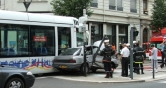
The term “public transport”, in the context of road safety, covers a range of different vehicles that may operate either on the road or on rails. Four main subcategories are identified: coaches (vehicles designed to transport passengers over long distances, mainly or exclusively with seated passengers), buses (passenger transport vehicles designed to operate mainly in urban areas, with both seated and standing passengers), trains, and tramways.
In 2024, 223 injury crashes involved a coach, representing 0.4 % of all injury crashes. In these crashes, 36 people were killed and 469 others were injured. Between 2020 and 2024, among the 123 people killed in coach crashes, 70 % were travelling in a vehicle other than the coach (i.e. 86 fatalities, including 21 vulnerable road users on bicycles or powered two-wheelers), 25 were pedestrians, and 12 were coach occupants. In 2024, there was one coach user killed for every five fatalities outside coaches.
A total of 664 injury crashes involved a bus, accounting for 0.5 % of all injury crashes. In these crashes, 17 people were killed, a lower figure than in 2023 (26), and 1 033 people were injured. Between 2020 and 2024, among the 97 people killed in bus crashes, half were pedestrians, 42 were travelling in a vehicle other than the bus, and 8 were bus occupants. In 2024, there was one bus user killed for every sixteen fatalities outside buses.
With regard to crashes involving rail-based vehicles, the BAAC databases recorded 154 crashes involving a tramway or a train in 2024. The two public transport modes show different accident profiles: while 8 people were killed in the 123 crashes involving a tramway (7 pedestrians and 1 car occupant), 19 people were killed in the 31 crashes involving a train.